Jennifer Lawrence Couldn’t Deal with ‘Hunger Games’ Fame

The Hunger Games” has made Jennifer Lawrence famous and popular all over the world. Playing heroine Katniss Everdeen in the hit movie franchise but admitted she was «terrified» the day after the first film came out in 2012 when she suddenly found herself being followed by photographers and recognised on the street. Jennifer told in her interview: «The day The Hunger Games came out was a bizarre one for me because I wasn’t famous 24 hours earlier and I got up to go about my day as usual and went to the grocery store.”
The Hunger Games set her career off into the stratosphere and since that first film she has gone on to win the Best Actress Oscar for her performance in Silver Linings Playbook and a BAFTA and Golden Globe for Best Supporting Actress for her role in American Hustle.

When someone says their computer is low on memory… what exactly do they mean? Are they running out of space to save files, or is the computer running slow?

System RAM (Random Access Memory) – this is generally in the range of 256 megabytes to 8 gigabytes on recent systems. This is where programs reside and run from while the computer is running. When you shut it down, it gets cleared – temporary usage, so to speak.

Hard Drive Space – this is generally 40 gigabytes and up – recently into the range of terabytes of storage. This is where your files are written to and read from. This storage is saved even when the computer is off. For example, you download 100 music files and save them. These get written to your Hard Drive, not system memory.

When people tell me that our President has delivered his 7th State of the Union speech recently, I always correct their mistake and tell it was eighth, in fact. On February 24, 2009, the start of Barack Obama’s 2nd month in office, he made an extensive speech on then ongoing Great Recession crisis. He tried to show what his personal vision for a path out was and why it was aligned with a $787 billion stimulus law that was passed that same day. Also, Mr. President talked foreign politics on that same occasion.

  1. Structured Analysis of the Situation;
  2. Hackers Can Steal Your Financial Info with Your Name and Email;
  3. He explained how well he will succeed in using diplomacy;
  4. That is confirmed by President himself.

He explained how well he will succeed in using diplomacy instead of Bush’s warmongering, strengthen old alliances and, all in all, spruce up US international image to a better one. He said: “living our values doesn’t make us weaker, it makes us safer and it makes us stronger.”

For me personally, 7 years later, all these is just a short summary of all the promises Mr. Obama failed to deliver to America’s doorstep. Roy Fowler

Even GOPers were approving of the path POTUS has undertaken then…at least of the rhetorics style, which he so Hollywood-esquely told it in.

All the great plans that could have made him a truly Reforming President
Structured Analysis of the Situation

All the great plans that could have made him a truly Reforming President, were not completed and so the 44th President of US will most likely remain an “intermediate” part of American history. That is confirmed by President himself, as he now constantly compares himself (unfavorably) to truly great US leaders, like Lincoln or Franklin Delano Roosevelt.

  • Structured Analysis of the Situation;
  • Hackers Can Steal Your Financial Info with Your Name and Email;
  • He explained how well he will succeed in using diplomacy;
  • That is confirmed by President himself.

And I have to agree with him. And the funniest thing is probably that Obama still managed to accomplish pretty big steps during his Presidency. Such as the “Affordable Care Act” (Obamacare), or achieving some kind of ease of US image overseas. Anyways, the way those great Presidents Obama mentions himself has changed the country is a great comparison.

Hackers Can Steal Your Financial Info with Your Name and Email

Remember the Republican response to Obama’s speech that day? One of the most famous ones was Bobby Jindal’s reaction. He just buoyed the stimulus plan that was just approved by the Congress. Even tried to mock it up, while objecting to spending “140 million US dollars for something vaguely called Volcano Monitoring…”. The irony is that next month after his words, the Alaskan volcano erupted (just as Obama’s intentions did) and covered the state for days with thick, 60000-foot ash and smoke cloud…

For me personally, 7 years later, all these is just a short summary of all the promises Mr. Obama failed to deliver to America’s doorstep. Roy Fowler

Quas animal voluptatibus nec an. No pri detracto posidonium, id vel unum sale vidisse. Case meis an ius. An usu viderer vivendum tacimates, ad pri sonet quidam commune, ea vis dico dicunt. Sed accumsan pericula in. No ornatus offendit suscipit eum. Feugiat invidunt instructior at est.

For me personally, 7 years later, all these is just a short summary of all the promises Mr. Obama failed to deliver to America’s doorstep. Roy Fowler

Like FDR, who was able to overcome the complete weakness of US federal government over private banks and financial sector in general, when dealing with the Great Depression. Or Lincoln, who held the bipartisan country together with a grip of a mountain grizzly bear.


Like FDR, who was able to overcome the complete weakness of US federal government over private banks and financial sector in general, when dealing with the Great Depression. Or Lincoln, who held the bipartisan country together with a grip of a mountain grizzly bear.
Suscribete a nuestro newsletter

Articulos
Redacción NorteGranCanaria

IA sí o IA no

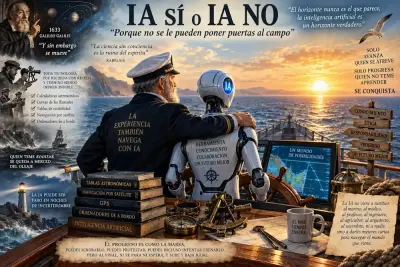
“Porqué no se le pueden poner puertas al campo” Durante semanas, el debate sobre la “inteligencia artificial” ha vuelto a encender tertulias, columnas y sobremesas. Hay quien la ve como una amenaza existencial, un monstruo digital capaz de devorar empleos, identidades y hasta la propia condición humana. Otros, en cambio, la consideran un avance inevitable, una herramienta poderosa que, bien usada, puede multiplicar nuestras capacidades. Yo, que he pasado media vida en la mar y la otra media escribiendo sobre ella, no puedo evitar recordar que este debate no es nuevo. Cambian los nombres, cambian los artefactos, pero el miedo al progreso es siempre el mismo. Recuerden que en 1633 casi mandan a la hoguera al astrónomo   Galileo Galilei, por afirmar que la Tierra giraba alrededor del Sol. Y el pobre hombre, para salvar de morir chamuscado tuvo que retractarse de su teoría heliocéntrica ante el Tribunal de la Santa Inquisición, aunque diciendo…. “Y sin embargo se mueve”, y como en aquel tiempo “los sabios de la iglesia” se parecían mucho a los actuales alumnos de la LOGSE socialista, no supieron interpretar sus palabras y gracias a ello, le perdonaron la vida.    “Cuando la mar también temió a la tecnología” Quienes hoy se escandalizan con las IA se parecen mucho a aquellos que, en mis primeros años de navegación, protestaban por la llegada de la “navegación por satélite”. Decían que se perdería el romanticismo, y que los oficiales se volverían torpes; que la mar castigaría a quienes confiaran en “máquinas que no sienten el viento”. Y, sin embargo, el tiempo puso cada cosa en su sitio. La navegación satelital no solo no destruyó la profesión, sino que “la hizo más segura, más precisa y más humana”, porque liberó al marino de tareas repetitivas y le permitió concentrarse en lo esencial; esto es, gobernar el barco y cuidar de su gente. Lo mismo ocurrió con las “calculadoras astronómicas”, con “las curvas de las llamadas, tablas americanas de estabilidad portátiles”, o con los primeros “ordenadores de a bordo”. Cada avance fue recibido con recelo, y cada avance terminó siendo imprescindible. Hoy, dudo que exista un solo barco en el mundo sin GPS, y también dudo que, muchos oficiales sepan usar un sextante como lo hacíamos nosotros. Pero eso no es decadencia: “es evolución”. “La IA como nueva herramienta de navegación humana” La inteligencia artificial es, en esencia, “una herramienta”. No es un oráculo, no es un demonio, no es un sustituto de la inteligencia humana. Es un instrumento que amplifica nuestras capacidades, igual que lo hizo el radar, el GPS o las cartas electrónicas facilita el trabajo. Acelera cálculos complejos. Democratiza el acceso al conocimiento y además permiten que un ciudadano normal, un estudiante o un profesional tenga a mano un asistente capaz de sintetizar información, explicar conceptos y ayudar a pensar. La IA no piensa por nosotros, solo “nos obliga a pensar mejor”.    “La ciencia sin conciencia: el riesgo real” Ahora bien, sería irresponsable ignorar los riesgos. La historia nos recuerda que, “la ciencia sin conciencia es la ruina del espíritu”, como decía Rabelais. El uranio, por ejemplo, prometía energía limpia y terminó también en Hiroshima. La química prometía fertilidad y terminó en gases de guerra. La informática prometía libertad y terminó en vigilancia masiva. La IA no es diferente. Puede ser usada para manipular, para desinformar, para automatizar injusticias, para amplificar desigualdades. Pero ese riesgo “no es argumento para frenar el progreso”, sino para gobernarlo con ética, regulación y responsabilidad. La solución nunca ha sido prohibir la herramienta, “sino educar al artesano” (pensamiento mesiánico)   “No se le pueden poner puertas al campo” La inteligencia artificial ha llegado, y no se va a marchar. Podemos discutir cómo regularla, cómo integrarla, cómo evitar abusos. Pero pretender detenerla es tan absurdo como prohibir el GPS en los barcos o volver a las tablas logarítmicas por decreto. La humanidad siempre ha avanzado cuando ha abrazado el conocimiento, no cuando lo ha temido. Y si algo he aprendido en la mar es que “el progreso es como la marea”, puedes ignorarlo, puedes protestar, puedes incluso intentar frenarlo… pero al final, ni se para ni espera, y sube y baja igual.   “El horizonte verdadero” Porque al final —y esto lo sabe cualquiera que haya hecho guardias largas en el puente de un barco, “el horizonte nunca es el que parece”. El aparente es solo una línea engañosa, dibujada por la luz y la distancia. El verdadero está más allá; donde la mar se junta con la voluntad, donde el futuro se abre como una derrota limpia y donde cada avance, por polémico que sea, termina siendo parte de la travesía humana. La inteligencia artificial es exactamente eso; “un horizonte verdadero”. No el que algunos ven con miedo, ni el que otros deforman con alarmismos, sino el que se revela cuando uno se atreve a mirar más lejos, más hondo y con menos prejuicios. Quien navega sabe que el barco que teme avanzar se queda a merced del oleaje. Quien se atreve, en cambio, descubre que el mar siempre recompensa al que confía en su rumbo. Por eso defiendo la IA a capa y espada, porque es viento nuevo en las velas, porque es carta actualizada en un mundo que cambia, porque es faro en noches de incertidumbre, y porque negar su avance sería renunciar al horizonte verdadero que nos corresponde como especie. La mar enseña que “solo avanza quien se atreve”. La historia confirma que “solo progresa quien no teme aprender”, y la IA, como toda marea que llega para quedarse, nos invita a seguir navegando hacia adelante, sin miedo, sin supersticiones y con la serenidad de quien sabe que el futuro no se detiene… “Se conquista”. La IA no es un enemigo; por el contrario, es un nuevo instrumento de navegación para la vida moderna. Si la usamos con conciencia, será una aliada formidable. Si la usamos sin ética, será un peligro. Pero renunciar a ella sería como navegar de noche